Showing posts with label Rasheed's Viewpoint. Show all posts

Saturday, June 04, 2011

Thoughts on Preparing for Episode 115...

Carnival in Santiago de Cuba

Yoruba

As I prepare for my show, sometimes I wonder how much I can explain without separating myself from some members of my audience. After all, the purpose of the show is to celebrate the oneness of the African Diaspora not fragment it. So, I never want to make too many distinctions as far as what I know because I’m a Caribbean member of this Diaspora.

What I wrestle with sometimes is the actuality that not everything that I know is common knowledge. For instance, planning this show on Fela means connecting the dots from present day Nigeria to the legacy of the Yoruba religion and culture. That sounds simple enough in theory but the idea of the Yoruba legacy outside of Africa is so vast and complicated that I realize there is a huge void of understanding between those of us who grew up with these core African themes and those who do not.

Mainland America, with maybe the exception of certain Deep South communities, was successfully purged of the unadulterated African concepts. Obviously, the Africans were not totally de-Africanized but the missing elements that survive outside of North America are pure enough to separate the cultural outcomes of South American and the Caribbean members of The Diaspora.

Just 90 miles separates Cuba from the United States of America but as far as African cultural elements, there is an ocean of separation. The faces in Mississippi, Alabama and Florida are just like the faces in La Habana, Santiago and Matanzas but there is no rumba in Alabama. So, when I think about Chango, Obatalla, rumba and guaguanco I must explain to my audience from North America that African ideas were not a daydream in the Caribbean. The shackles that bound our bodies were the same but the shackles that restricted our souls were not. If I find myself talking a lot about traditional African religion on this show, it’s because it totally shaped our worldview. The drum and the music that it symbolized are not an African influence, as I’ve heard so many educators say, they are Africa!

Who influenced whom? We, after all, represent the first world culture. There is no coincidence that the former Portuguese and Spanish colonies stand out as the bastions of African Cultural preservation. Their proximity to Africa meant they were already unable to resist the influence of Africa. The English, Dutch, Danes, Germans and French were much more resistant to the African’s influence. Maybe, it was merely the affectations of a lack of geographic proximity.

Sometimes there seems to be resentment in some of us, when North and South American Afro-descendents get together. Yet, that which was preserved must be shared by whoever was entrusted with guarding it.

Thursday, April 21, 2011

"One Tribe, Many Voices" Podcast Episode 109

One musical group has embodied the Africanization of the American beat: Earth, Wind and Fire.
This week's show focuses on the special musical and cultural contributions of Earth, Wind and Fire.

This is actually the second part to last week's show celebrating 'Africa in America', or the Africanization of Black music in the United States. To some readers, referring to the Africanization of Black American music may seem like an odd reference. Yet, from my African-Caribbean mindset and viewpoint, the lack of real African drums and traditional rhythms created an unusual musical identity in the United States. The beat of the drums underwent a transmutation and was hidden in a new syncopated version of European styled music.

Painting: Varnette P. Honeywood

I can recall when I was younger, hearing Afro-Americans reluctant to connect any part of themselves or culture to an African identity. Kids would declare: "I aint no African!" To them, Africa was a primitive, foreign identity. That attitude has not really disappeared from the American mindset, it has just morphed into a new one that identifies African culture as that of US immigrants. So, now African culture is something new that comes from Nigeria, Ghana or Senegal. For those of us from the tropical zone, our Africanisms are much more difficult to deny. Though the same affliction of shame abounds in the minds of the African Diaspora where ever they reside. Still, whether confusion of 'what to call ourselves' exist or not, everyone knows that Calypso, Reggae, Merengue, Samba and Guaguanco are all African musical expressions and forms. Earth, Wind and Fire connected the dots between Africa,Brasil, the Caribbean and America.

Intro: Evil / Earth, Wind & Fire / Head to the Sky

Set one:

1. Partido Alto / Flora Purim & Airto / The Colors of Life
2. Fair but so Uncool / Earth, Wind & Fire / Open our Eyes

Set two:

1. Ponta de Lanca Africana / Jorge Ben
2. Time is on Your Side / Earth, Wind & Fire / Last Days in Time
3. Caramba / Jorge Ben
4. Let me Talk / Earth, Wind & Fire / All n' All

Set  three:

1.Runnin' / Earth, Wind & Fire / All n' All

Set four:

1. Cru-Cre Corroro / Ivan Lins / Awa Yio
2. Serpentine Fire / Earth, Wind & Fire / All n' All

Set five:

1. Brazilian Rhyme Interlude / Earth, Wind & Fire / All n' All
2. Ponta de Areia / Wayne Shorter w/ Milton Nascimento / Native Dancer
3. Bird of Paradise / Stevie Wonder / Fullingness First Finale
4. Brazilian Rhyme / Earth, Wind & Fire / All n' All

5. Fica no Brasil / Rasheed Ali & Rain People / Tristeza e Beleza


Tuesday, April 12, 2011

"One Tribe, Many Voices" Podcast Episode 108

This week's show is a reminder that the journey of African-Americans in the United States towards acceptance of their African identity has been a long and winding road.

There have been waves of Afrocentricity that have ebbed and flowed through the courses of US history. This desire to learn more about a forgotten legacy often at odds with a desire to "move on" and become an accepted member of a uniquely American identity. For many in the United States there was a legacy of shame and denial made easier by the absence of a strong, easily identifiable African culture. Surely, the Africanisms are present in the expressions of a US culture but the dots were never really connected to Africa. Instead, these cultural affectations were heralded as being the fabric of a uniquely American expression. Jazz, blues, gospel, rhythm and blues all being viewed through the prism of a post-slavery expression. Though there may have been some resignation that Africa was too distant a memory to uphold for the formerly enslaved, the slave masters certainly promoted this concept to their benefit.

Unlike the Caribbean and parts of South America, the playing of the traditional African drums were banned in the United States. This might seem to some as a civil ordinance rather than the evisceration of an identity. To those who think the drums are merely musical instruments, it is not easy for them to understand that the drums occupied such a central force in the spiritual lives of Africa's people. the drum was an instrument for communicating with the divine. The drums and their usage also drew lines between African tribal and ethnic groups. For instance; taking away the Ashanti drums from the Ashanti meant taking away a language that separated them from their neighboring states and ethnicities. For those who see Africa and Africans as a mass of Black People, this subtle nuance of history is lost. Of course, the Africans south of the Rio Grande River overcame this by merging some universal aspects of their differing cultures. As in Brasil and Cuba, were elements of Yoruba, Ashanti, Dahomey and Congo cultures forged a sometimes indistinct musical and liturgical mixture. It was certainly more advantageous to preserve a collective African identity than to quibble over the details of ethnic delineations.

In the US, the African ceased to exist as an African, they were transformed into Blacks. The monolithic concept of Africans as Blacks that still persist in America has also been promoted as a worldwide concept. Africans never referred to themselves in this way. Africa was never monochromatic, this false identity became a real detriment to the cultural understanding of the African Diaspora in the US.

This false identity continues to be promoted in the image of Black History in the US. As a public school teacher I have participated in many Black History Month Celebrations and the content is always focused on a post-slavery reality.

As a Caribbean-African I have no desire to down play the fact that my Caribbean culinary diet, musical expression, cultural nuance and syntax are heavily African in identity. While this pride has often been resented by those of the African Diaspora of the United States, it must be expressed unabashedly.

There is a need to celebrate any surviving African identities rather than merely celebrating surviving slavery. There are African cultural identities to be found in the US, if you look hard enough.
The culture and people of the Mississippi Delta have been looked down upon by many in urban America. Yet, much like the Caribbean and Brasil, this region of the US represents a fertile crescent of African culture that should be revered. In looking back to Africa we must not forget where to look for Africa in America.


intro: The Drum / Sounds of Blackness / Africa to America


Set one:

1. Took Away the Drum / Mighty Mo Rodgers / Blues is My Wailing Wall
2. I Know Why the Caged Bird Sings / Branford Marsalis / Buckshot LeFonque

Set two:

1. Going Back to My Roots / Lamont Dozier /


Set three:

1. Say it Loud / James Brown
2. Black Man / Stevie Wonder

Set four:

1. Africa / Rasheed Ali & Rain People
2. Ngiculela, Es Una Historia / Stevie Wonder

Set five:

1. A Change is Gonna Come / Neveille Bros. / Yellow Moon
2. Blues is My Wailing Wall / Mighty Mo Rodgers
3. Looking for Ekwiano / Rasheed Ali / Thunder in the Jungle
4. I Will Cry for You / Rasheed Ali / Thunder in the Jungle


Sunday, April 04, 2010

"One Tribe, Many Voices" Podcast Episode 65


This week, the podcast radio show features the Rain People sound.

Afro-Centric and Pan-African are unifying themes that express the "Black Music Without Borders" concept of Rasheed Ali & Rain People. The music of the African Diaspora comes in many voices, many tongues. In the New World we Africans were often chained together and housed with fellow Africans that did not speak our tribal language. The colonial slave owners used this tactic to help keep order and keep us somewhat separate. The historical record provides a validation for this point.
Now, in the New Millennium, African descendants such as myself are reconnecting our tribal links. We came as Yoruba, Ashanti, Mende, Fulani, Bantu, Fon and many more before adapting to the foreign tongues. Spanish, Portuguese, French, Dutch, English, Chinese and Hindi have all intertwined with the African tongue in the New World. Language is not a barrier for those who embrace the concept of "One Tribe, Many Voices". Celebrating unity!

Intro: Na Cidade Negra

Set One:

1. Thunder in the Jungle
2. Tristeza e Beleza
3. El Tumbadero

Set Two:

1. Agua Que Va Caer
2. Baye Fall
3. Nao Precisa Ainda Nada

Set Three:

1. The Teachers
2. A Cara Que o Mundo Ve
3. Uma Coisa Boa, Uma Coisa Doida

Set Four:

1. Cocinando
2. Let it Rain
3. Eu Sou o Seu


Thursday, February 18, 2010

The masterful writer who wrote 'The Three Musketeers'.


While I enjoy Gerard Depardieu as an actor, his choice as the actor to portray the great writer Alexandre Dumas, in Black face, is an awfully racist faux pas that should be met with some sort of organized reaction by African Diaspora people who are tired of Eurocentric insensitivity and arrogance. Let's have Denzel Washington play the Great Bard himself, William Shakespeare in White face.


Thursday, June 25, 2009

A Charmed Life Comes to an End!


He came into our lives as a precocious child. A young boy with a giant stage presence and an angelic voice. Young girls swooned and old folks marveled at the savvy soulfulness of his stage moves. He was Marvin Gaye, Jackie Wilson, Frankie Lyman, Little Stevie Wonder, James Brown and Sam Cooke all rolled into one little boy's body! He was unique and he was ours. He belonged to Black America and he was as Black as the Black town that launched his career; Gary, Indiana.
Yet, ultimately, he became an ambassador of Black American culture to the entire world. His bravado and his youthful swagger became iconic signatures that were copied the world over. Tune into variety television anywhere in the world and you will see his stage moves and dance steps recycled daily. The next time you watch a Bollywood movie look for Michael Jackson's imprint on the production numbers.


In 1977, I had the distinct pleasure of meeting and speaking with Michael Jackson. I felt sorry for him because he seemed so painfully shy but his warmth and kindness were genuine.

His gentle voice will continue to echo into eternity...

Monday, April 13, 2009

Rasheed's Birthday April 13th, 2009


I'm happy to still be here, above ground, in this plane of existence on planet Earth.

We all have a path to follow and mine has mostly been working through my artistic expression to touch the lives of others. Music and the Visual Arts have continued to serve my well. The new frontiers of Citizen Journalism and New Media have allowed me an uncommon access into the lives of countless listeners and viewers worldwide.

For those who may read this and wonder aloud if Rasheed Ali & Rain People still exist in the world of live performance: I have not abandoned my mission to bring Rain People's multi-language sound of African Diaspora music to difference parts of the world. Like the Phoenix Bird we shall rise again from our current abyss of hiatus!

I want to personally thank each and every one of my supporters. Those who have bought my CDs and downloaded my music, those who regularly listen to my podcast radio show, those who connect with me on the various social networking sites, those who write me encouragement and acknowledgement through this blog and those who help me to continue my mission against all odds! THANK YOU ALL!

Monday, January 26, 2009

Message from my friends in Brasil and more...


Any euphoria withstanding, we must admit as members of the African Diaspora that certain concepts of racial angst have been compromised and made bankrupt by Barack Obama's ascendancy to the presidency of the United States. Though I don't think racial prejudices will die a quick and certain death, I do believe our ancestors are smiling. For people such as myself, who live within a world of promoting and celebrating African Diaspora history and culture, we do not want anyone to compromise or bankrupt the realities of our Holocaust experience. I hope a part of this "new era" will be an honest look at the past, not ignoring and minimizing it.

Sunday, January 04, 2009

Little Voices in the Wilderness: Gaza Invasion


On Friday, January 2ND, 2009, I felt compelled to add my little voice to a protest in front of the Israeli Consulate in Los Angeles, California.

I only wish that my little voice in the wilderness would matter. While standing in the chilling cold weather, I felt a certain futility that my little voice did not matter in this great big world. It seems that a world that has so many conflicts cannot focus on every cry for reason.


I live in an American world where Palestinian lives are not equal to the lives of others.

I am not Palestinian but I am a human being that must respond to injustice and ugliness.
I am a Caribbean-American not an Arab-American but I felt a certain shame if I did not raise my little voice in protest.

Friday, November 21, 2008

The truth about the African Diaspora!


What does the Rain People motto: "One Tribe, Many Voices"
really mean?

Who is the African Diaspora and what do we have to say?

Anglo-centric Black American people of the African Diaspora never give much thought to the fact that the majority of Africans do not speak English as their primary language.
Nor do they realize that the majority of Africans in Africa are multi-lingual; speak their own ethnic language and the languages of their neighbors as well as the language of the former colonizers.
There are an estimated 2,000 languages spoken on the African continent and millions speak Portuguese, Spanish, French, Dutch, Arabic and Italian.

I think it is fair to say that Africans have many voices and if you want to hear what Africans have to say; you must take time to learn another language!

Wednesday, November 05, 2008

An historic event gives pause for reflection.


Yesterday morning, November 4Th, 2008, I awoke early with the knowledge that the election polls would open at 7am here in California. I drank my coffee in record time and I made it to my local election polling place by 7:30am. There was already a line of anxious United States citizens assembled. When it was my turn to enter the voting cubicle, I called for assistance because I was new to the process. I had never voted in an American election. I had never felt compelled to be involved in the process of selecting anyone for presidency of the United States. I was one of those jaded residents of this country who did not feel represented nor did I care. After all, I was only a hyphenated American: Caribbean-American, African-American, Latino-American, West Indian-American....but certainly not simply "an American".

I never felt that America was a place of permanence for me. I felt I was only here on borrowed time, to become successful and return home to the Caribbean like my parents did. I thought that voting was something for the 'real Americans', for the 'Yankee People'. As a musician and as an educator, who has spent years teaching and inspiring vulnerable children, the arc of my life can be described by the definition of 'social activist'. Still, I chose to do my part within an apolitical context.

Many Caribbean people have been activist from the moment we arrived here. Black pride or pride in our African roots was never something to be ashamed of, we had no choice! Our music and our food and our outlook was and is very different from that of "regular Americans". When we first arrived here in numbers, we changed the landscape of racial pride in New York City and we helped to fuel the Harlem Renaissance with a new breed of intellectuals. We simply had no choice but to bring our true selves and our true outlook. Yes, we were Black and Brown people but we didn't come here to "mind our place" and pay heed to America's racial traditions. We brought a new viewpoint embodied in immigrant arrivals and first-generation Caribbean intellectuals and political leaders like Arturo Schomberg, J.A. Rodgers, Claude McKay, Malcolm X, Shirley Chisholm, Stokely Carmichael, Charles Rangel and even Louis Farrakhan.

In fact, it was NY congresswoman Shirley Chisholm who was the first African-American major party candidate for the presidency of the United States in 1972.

Barack Obama gave me a reason to be involved in a way that I never thought necessary. I donated money to a political campaign. I attended a local Obama organizing event. I sent e-mails and I told everyone who would listen, including the readers of this blog, that he was a uniquely positioned individual who could make a difference on the world stage.

As a student of history, who had listened to the great Dr. John Henrik-Clarke speak at a lecture hall in Hunter College, I shed tears for all of our African people who died before this day of redemption. Barack Obama led me past my own jaded view of America to a feeling of urgency that I should finally participate fully in the American dream. I am still a hyphenated American but I am one who voted for Barack Obama for president of the United Sates!

Yesterday, my oldest son, Kareem also voted for the first time in his young life but he already has reason to believe in America's "better angels".

I witnessed the birth of both of my sons, Kareem and Rohan, but last night I witnessed the birth of America's future. Born of a tortured past and the audacity of hope, Barack Obama emerged not as a child but a man.

Wednesday, July 16, 2008

Barack Obama: The Jackie Robinson of Politics


Let me expound upon the concepts of the New Yorker cover:

Ultimately, the real issue at stake is the liberties that the media will take with regards to how they portray Senator Obama's bid for the presidency of the United States. What we see playing out in the popular media is a collective subconscious of the largely Caucasian-controlled media.
To monitor the media in the U.S. these days is to monitor a collective sampling of a people wrestling with their own bias, prejudice, guilt and racial attitudes. We people of African descent, in particular, are neither surprised nor dismissive of this reality of racial inequity in reporting news. This entire process is not new to us at all. In fact, it is tradition in the U.S. to heap every kind of disrespect and indignity upon the head of any Black pioneer.
The men who broke the color line in major league baseball, Jackie Robinson and Larry Doby, had to endure racial bias not only from Caucasian teammates and fans but from the media as well. Years later, that same media serves as the guilty conscious for an America who decries a racist past in award-winning documentary movies. Today Robinson and Doby are indeed celebrated, not for their athletic achievements as much as they are celebrated for being able to endure the racism of the day.The real revision in this popular history lesson is the absence of a true portrayal of the media's complicity.
Racial bias is always granted a pardon by its practitioners. Unfortunately, we see this absolution of racism play out on a daily basis in the popular media. Racist ideas are floated daily then they are excused or dismissed as being a faux pas or fringe idea. The fringe of what? Is that fringe the ragged edge of a racist fabric of American life? Once the bell has been rung it has served its purpose to remind everyone that attitudes of superiority do not die an easy death.

Jackie Robinson had to be the perfect example for a race of people. He was to be the standard bearer for any Black man who would choose to conquer the status quo of America's color line. He was given a choice; grin and bear the insults and pain or spoil things for the rest of your race by defending yourself and striking back.

Sixty years later; we are watching Barack Obama grinning and bearing the insults just like Jackie Robinson.

Monday, May 19, 2008

75,000 People Attend Obama Rally in Oregon!


Despite the posturing and bravado of republican candidate John McCain, I get the feeling that it is a bit terrifying for him to realize that Barack Obama has the ability to galvanize real human support.
It is no small feat to be able to attract crowds of 60,000 people in Michigan and 75,000 in Oregon. If Senator Obama is likened to a rock star what shall we liken John McCain to?

Can John McCain duplicate grassroots support that Senator Obama is able to mobilize?

Most of his recent public speeches have been at events such as the National Rifle Association meeting as opposed to electric public gatherings where he is the main attraction.

I can only wonder if he can create the need in 75,000 people to attend one of his speeches.

We shall see.

Wednesday, May 07, 2008

The Audacity of Hope is Inspirational


Barack Obama's quest for the Presidency of The United States of America has captivated the world. There is an electricity about the man that cannot be denied. Even his greatest detractors are aware of the dynamic presence that he presents. Beyond mere charisma and oratorical eloquence, Senator Obama has a shining light that must surely be intimidating to those who would wish him to fail. When he is attacked by his political opponents, he deflects the negative blows with grace. He has continually chosen the high road of positive force as a response. Only a uniquely confident individual could refuse to embrace the negative tactics of dirty politics.

The audacity of his campaign is truly inspirational for the enlightened. Creative people, like myself, understand the brilliant energy that Obama exudes. It is no small coincidence that people refer to his speaking engagements as being "like a rock concert". He is not an actor nor a performer but he creates a feeling that regenerates his audience. This energy resonates especially with young people because it is a youthful energy. Obama is able to impart the importance of the moment to his listeners. He is able to energize people with the sense that they can seize the time.

He makes me feel as if my own audacity, to be a 'roots' musician in an 'American Idol' world, can pay off. Thanks to Barack Obama, I feel a renewed purpose in my own quest.
Thanks Obama!

Sunday, October 22, 2006

My Next CD is Inspired by Katrina


"Katrina"

For us, Caribbean People, hurricanes are not para-normal events. You grow up hearing stories about devastating hurricanes and you get to experience a few yourself.

In fact, there have been a few hurricanes that have contributed to the migration of Island People to the States!

True fact is...most hurricanes develop off the coast of West Africa, churning through the Middle Passage. Many an African met their demise along that route of kidnapped and enslaved people. One of my good friends said it was a strange irony that storms come up from this watery burial ground to reek havoc on the Americas.

"The Invisible made Visible"

Katrina stripped America naked, exposing the world to the stark realities of an invisible economic underclass that toils within the shadows of America's opulence. Many people navigate the daily treachery of Urban America with profound ingenuity but "the roof was torn off the house" and even the strong could not survive!

"The Rain Does Not Fall On One Roof"

-Ewe (Ghana) Proverb

African Wisdom reminds us that we are all subject to the sovereignty of the Earth's Elements.
___________________________________________________________________

"Hurricane on the Horizon" was inspired by Katrina and some other world issues. Unlike my last few CDs this CD will be entirely in English.

Saturday, September 23, 2006

The Living Dead...

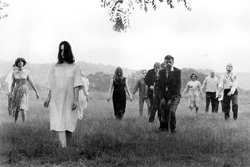
It is the nightmare that I am living. It is the night of the living dead.
They are walking the streets next to me. They are in the car next to me on the freeway. They are at the grocery store, on line in front of me, on line behind me. They are everywhere; the living dead. They just bought the house next to mine. I see them on the television.I hear them on 'talk radio'. At least they are not 'here' reading my blog. I am happy for that. I do not have to worry about them being 'here' because they cannot read. The living dead have eyes but they cannot read. Here; I am safe!

Wednesday, September 20, 2006

What Does Any Of This Have To Do With Music?

When I pick up my telephone these days it makes a terrible sound. It's a sound that you used to hear years ago when you were making an overseas call. It's an odd sound because we know that telephones can be tapped silently but somebody made a mistake with my phone. This odd sound is an obvious reminder that someone out there thinks that I am worthy of a wire tap.

Could it be because I'm a World Music Musician?
Is it because I'm a Recording Artist who has recorded several CDs?
Is it because somebody out there has heard one of my songs on the local World Music Radio show?
Is it because somebody read one of my Blog postings and decided they'd rather hear my actual voice instead?
Is it because I've been interviewed by the L.A.Times Sunday Section?
Is it because I my art work was included in a Smithsonian Institute Traveling Exhibition? Maybe It's because I've been on a National Television Commercial that ran for a few years, it must be that, right?

Or is it because the last name on my passport is: Ali and I've taken a few plane trips in my life?

Before September 11, 2001; I was never asked to exit the passenger boarding line on an international flight and interogated by the Federal Police of a foreign country.

Before September 11, 2001; I never noticed well dressed, clean-cut individuals sitting in sensible American sedans parked outside my tree lined residential street.

Of course that was before the dawning of The New World Order:Part-2.
Does any of this have anything to do with music, anyway? So guys, please tell the other guys
(on the silent end of my telephone) that I'm just a musician.

Oh yeah, if you've never heard my music and you're not a fan, please tell the guys at Homeland Security that I need CD Sales badly.
I'm on iTUNES and many other download sites like; Rhapsody, Napster, etc.
Hey! I'm even on Verizon Ringtones, in fact in Japan you can download my music to your telephone guys. I just want to make your surveillance down-time pleasureable and interesting. Just trying to do my part for National Security. I figure we don't want any miserable D.H.S. agents out there without any cool sounds on their iPOD.
If all else fails, how about the next time I make an out going call, I can blare my music into the telephone. Ok? I know it sounds ghetto but then you can make a mix tape of my conversations and my music and download it to your iPOD.

On second thought; can you guys just go to CDBaby.com and purchase my CD ? If you're really cheap, you can download my individual songs for $.99! Please guys, help me out here!

Anyway, sorry I'm so long winded guys but then again you guys already know that I hate the telephone. Duh! Give my regards to John Ashcroft... Oh, that's right...he's not with you guys anymore. Peace!

To Get DHS /FBI / CIA Special Discount on all Rasheed Ali & Rain People CDs Click This Link!


Tuesday, September 19, 2006

What is this unique love that we Island People share?

Sure, all people have some sort of attachment to their homeland, their people, their culture or their region. Many people have some tribal attachment to their race or color but few people share the unique bond that Caribbean people share.

In order to understand this phenomena we must first look at the name Caribbean and its origins.
If you look at most sources they claim that the region was named for the indigenous Carib Indian Tribe. Historical evidence affirms the Arawak, Taino, Ciboney, Kaniripbuna (Garifuna) & Lucayan tribal names but what about the name Carib? There is no evidence that the indigenous people called themselves Carib. In fact they called themselves: the Kalinago. It was the Europeans who called these people the Caribs. While Christopher Columbus was still on first voyage he picked up the word, or something like it, from the Tainos on the Greater Antilles. Why is understanding the name Carib important to my essay on the region?

My knowledge of Arabic led me to contemplate the mistake with the name.
I think it is really interesting that the Arabic word: Qaribun translates as; something that is close in proximity or related. Qaribeena would refer to; several things in close proximity or relationship, relatives or kin. What is easily overlooked is the fact that many crew members among Christopher Columbus' expedition spoke Arabic as well as Spanish. The sailors would obviously had commented on the relative sameness of the tropical island chain that arcs from Trinidad to Cuba. They would also have marveled at the relatively short nautical distance between islands. It is easy to imagine the sailors calling these islands: the Caribbean Islands.

The feeling of kinship among Caribbean people is stronger now then ever before. In today's post-colonial Caribbean the boundaries of language are being erased. Bob Marley was at first embraced as a Jamaican hero then as a West Indian hero but now the entire region celebrates him as a Caribbean hero. Whether people speak French, Spanish, Dutch, English or Portuguese there is a great pride in a Caribbean culture that easily translates from island to island. As our traditional African rhythms can attest, the veracity of our roots bears witness not to our colonial masters but to our African ancestors. Our unique preservation of religion, food preparation, language syntax, customs and artistic culture is staggering. Yoruba elders in Nigeria were recently amazed at how well Yoruba language and rituals were preserved in Cuba after hundreds of years removed from Africa. Elements of the two most powerful ethnic groups are easily distinguished among the Caribbean's traditions. The Congo (Bantu) left their spiritual outlook and cultural mark on every island. The well organized Yoruba left their powerful religious influence and fraternal concepts. The cultural influence of these dominant groups helps to link the islands in a profound way. Despite the colonial efforts to decentralize the unity of enslaved Africans. The 'Creole Africans' of the Caribbean found a way to form a cultural consensus for their traditions. The resulting cultural confederation allowed all of the Diaspora's ethnic groups to contribute to the Afro-Caribbean culture. The proportions of the ethnic mix was different from island to island. In some islands there might have been more Mandinka or Mande, on other islands more Akan or Aja peoples. The melting pot of the Caribbean begins with the mix of Africans not to mention the host of would-be colonizers. Some islands changed hands several times, leaving a mix of disparate European influences to compliment the African mix.

Thanks to the landscape of urban centers in the United States, Caribbean immigrants are forging yet another identity as they create a new Creole mix for the 21st century. Today, island people are interacting with each other more than ever. Despite the close proximity of the Caribbean islands, inter-island travel was not necessarily easy in the past!
Urban centers like Toronto, Brooklyn, Miami, Boston, Washington DC, London,etc. are helping to facilitate social intercourse & intermarriage among Caribbean people. As we reclaim our real heritage I expect we will discard the false mantel of colonial identity. I expect we will identify less with the French-Caribbean, the English Caribbean, the Spanish Caribbean or the Dutch Caribbean.


Wednesday, September 13, 2006

Trying to Stay Creative When Hatred is Everywhere

I have devoted the majority of my life to the pursuit of my Art, my Craft: Music.
Despite my devotion to my creative forces, I do not worship music. Music is not my God!
Music is, however, the means that I utilize to serve my God. What does that really mean?
It means that I am an extreme pacifist that has found the same state of transcendent peace in music as I have on the prayer rug.
I have found the same trance-inducing intoxication in the dynamism of my drumming as I have in the recitation of my prayers.
I have expressed the joy of lyricism with my piano and my compositions just as I have earnestly delivered the call to prayer.
By remaining creative in the face of fascist hatred; I honor the ultimate creative potentiality of the universe.
When the ugliness of loud voices threatens to render my altruism paralyzed; I make a joyful noise.