Showing posts with label Brasil. Show all posts

Friday, November 21, 2008

Dia da Consciência Negra em Brasil!


Today, November 20Th, is the National Day of Black Consciousness in Brasil.

For millions of Brasilians this is a day of great pride, a day of black awareness (consciência negra) in the nation that held the most enslaved Africans in the Americas, where legal slavery lasted until 1888.

It is the day, in 1695, when Rei Zumbi dos Palmares was captured and beheaded by the Portuguese military for leading the greatest Maroon colony (Quilombo) of escaped Africans in the Americas. One hundred and ninety-three years before the abolition of slavery in Brasil, the barbarous Portuguese took Zumbi's head and displayed it in the city of Recife 's main plaza so that enslaved Africans would know that he was not immortal. Still, they could not kill his legend nor the legacy of the Palmares settlement over which he ruled at the time of his death.

Founded sometime in 1630, during the war between the Dutch and the Portuguese, the maroon settlements in the highlands of of Alagoas proved to be a place of sanctuary for many enslaved Africans who took advantage of the confusion of war to escape. Among them was a man from Angola who is now known by the honored title of Nganga Zumba. As head of the council of villages which became known as Palmares or Angola Janga (New Angola), Nganga Zumba was regarded as the patriarch or king of the settlement. By 1670, the community had grown into a small nation-state of approximately 30,000. The quilombo had to stave off many attacks by the Portuguese army but in 1678 Nganga Zumba, tired of the constant warfare, accepted a peace treaty that required that they relocate. His acceptance of the treaty caused a split among the community and led to Nganga Zumba being poisoned. Those who accepted the treaty and relocated were summarily re-enslaved! Nganga Zumba's nephew, Zumbi, had opposed the treaty and he was taken as king by those who decided to stay in Palmares. Zumbi valiantly led the quilombo of Angola Janga for fifteen years against Portuguese attacks until he was defeated in 1694. Forced into hiding and wounded after the defeat, Zumbi continued to fight as an insurgent against the Portuguese for nearly two years until his hideout was betrayed.

Tuesday, May 13, 2008

Blue Kisses from Bahia

This video is only a sampling of Bahia, Brasil.


My new CD is gradually coming to market.
At present,it is only available for sale at
CD Baby.com

The name of my new CD is "Beijos Azuis".
For those who do not understand Portuguese; 'Blue Kisses'.

Only in Bahia could such a simple phrase have such deep meaning.
Salvador is a city who wraps herself in blue and white; the colors of (the Yoruba orisha) Yemanja. She represents the feminine principle.
She is the image of the mermaid who beckons seductively to lonely sailors.
When a person sends you 'blue kisses', it is a kiss from the deep blue sea of romance. It is a kiss with saudade (a reflective romantic longing).

"Beijos Azuis" is my musical love letter to Salvador da Bahia. I hope that I've done my job as a creator, to paint a magical portrait of Brasil's most magical city.

In coming weeks I will go into greater details about Bahia.
Please visit the links to "Beijos Azuis" so that you can hear the music.
If you want to keep Bahia in your heart as I do, buy the CD today!

Friday, November 17, 2006

My War Against Eurocentric Academia


I just received a comment concerning my last post: "The Call of the Berimbau". Unfortunately, it was posted anonymously. If you post a comment anonymously you are unlikely to actuate a real dialogue. I am rather annoyed but I am not anonymous however.
cientista wrote:
"Actually the Berimbau predates colonial Brazil and therfore capoeira. In fact it is widely believed that it was not introduced into capoeira until the late nineteenth century. As a result it is frequently played outside of capoeira with other significance."
_____________________________________________________________________

For those who don't know me I will explain that I am also a classroom teacher. In fact, I am on my way to school now! I awoke to this comment that hints at misconceptions that I cannot overlook. Though e-mails tend to lack a certain defining nuance that explains more about a person's intellectual stance, I think I understand where this person is coming from.
So, my disclaimer is; I may have the wrong handle on this person's intent but here's my response.
The person also sent me information on the origins of the Berimbau, so let me give them information as well.
________________________________________________________________

Firstly, I teach the origins of the 'berimbau' everyday. Most recently at Occidental College.
I have constructed 'berimbau' and I have spent hours listening to their music in Brasil and South Africa.
The "berimbau" is only one ethnic group's representation of the world's oldest musical instrument. The one-string musical bow. It not only "predates" capoeira it predates the drum, the flute and all other instruments. It was most likely derived from a bow & arrow used by hunters. It is found primarily among the people of the southern portion of Africa; southward from Angola through Namibia to South Africa. The so called "Bushman" or Khoisan have several versions.
When I was in South Africa to lecture at Stellenbosch University I became quick friends with a music professor who is writing a book on the indigenous musical instruments of southern Africa.
She shared with me her many primitive 'berimbaus' and 'quicas'. She has also gone out into the Kalahari Desert and taken video of Khoisan using this very ancient instrument. I felt as if I was transported back in time by this truly aboriginal instrument.

I am constantly at war with western academia's assertions about the world's oldest society:Africa because every shallow European viewpoint is assumed to be expert and sacrosanct.
To state that the berimbau predates the art of capoeira therefore is to state the obvious. To say that it wasn't "introduced" to capoeira until the late nineteenth century is misguided intellect.

To say that the 'berimbau' was "introduced" to capoeira is like saying that the conga was introduced to the rumba.

The historical record proves that the majority of enslaved Africans taken to Brasil were from the area of Angola. The 'berimbau' had already been a part of their cultural expression for countless centuries. In the 'New World' of the Americas, the Africans ability to express the full lexicon of their cultural expressions was limited by their position in white society. Very little of the African's true identity was expressed openly upon his arrival in the Americas. We were not an 'immigrant' group we were a kidnapped group!

The capoeira master's (Mestre Accordeon) statement: "The exclusive use of the Berimbau to make music with no relation to Capoeira is like using an authentic Samurai sword only for pruning the back yard". is a statement of great dignity.
It reminds us that everything that the African preserved was inescapably tied to a spiritual code. It is a cornerstone of African principle that is the core of the African's cultural survival.
His statement is very clear; if you want to practice capoeira then it must be performed to the soundtrack of the world's oldest instrument, it must always be acknowledged as being a link to the past. In Cuba and Puerto Rico we have the same chatter concerning the Bata drum. The Bata predates the African's attempts to hide his true identity as a Yoruba just as the Berimbau predates the African's attempts to hide his true identity as a Bantu.

Wednesday, November 15, 2006

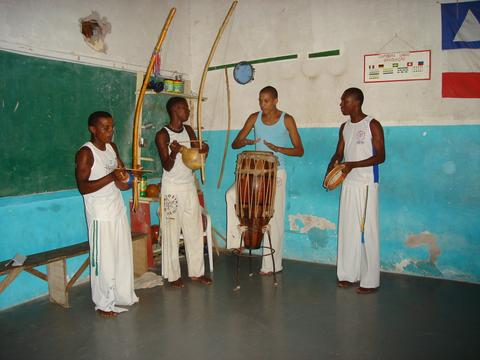
The Call of the Berimbau


"The exclusive use of the Berimbau to make music with no relation to Capoeira is like using an authentic Samurai sword only for pruning the back yard". -Mestre Accordeon-

"It is impossible to learn Capoeira without the Berimbau."
-Mestre Bimba-

"The Berimbau speaks through the gourd to the Capoeirista."
-Mestre Accordeon-

Teaching American Kids: How to be Samba Kids

Tuesday, September 26, 2006

"Fica no Brasil" (Stay in Brasil) Underground Version

Artist: Rasheed Ali & Rain People
CD:Tristeza e Beleza na Cidade Negra
(Sadness & Beauty in the Black City)
Label:Digital Rain Factory 2005

Rasheed ali composed and recorded this music in Salvador da Bahia, Brasil in 2005.

Tristeza e Beleza (Underground Version)

Artist:Rasheed Ali & Rain People
CD:Tristeza e Beleza na Cidade Negra
Label:Digital Rain Factory

Sunday, August 06, 2006

A Very Cool Human Being


My son Kareem and I backstage with Lenine.
One of the great musicians from the musical city of Recife, Brasil.
Thursday August 3, 2006


When I saw Lenine's concert in Brasil, I was amazed at the devotion of his fans.
The audience sang every word of all his songs.
His deeply poetic words echoed through the concert hall.
I became a fan of his in 1993 when his cousin Ivan shared his first CD: "Olho de Peixe" with me.
I value Lenine's intelligent lyrics and ironic artistic stance but above all; he is a very cool brother!

Saturday, August 05, 2006

Lenine, Brazilian Super Star!

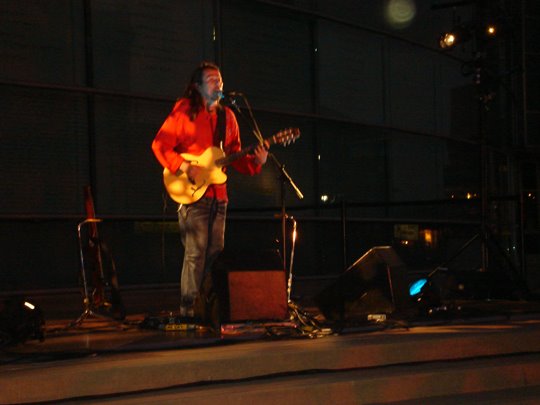
I'm happy to say that I went to Lenine's concert performance here in Los Angeles on Thursday night, August 3, 2006. Though he is a super star in his own country, Brasil, he is virtually unknown in the US.
The singer-songwriter performed without the aid of his talented band.
He courageously performed his repertoire solo and 'unplugged'. Stripped bare to a mixed audience of ex-patriot Brazilian fans and curious Angelinos, Lenine carried his music with a powerful honesty. His inner rhythm was enough to power him. Lenine's ironic poetry was largely lost on an audience of Americans who were clueless to Portuguese but his music was easily felt. I had many funny thoughts running through my mind. As I usually do, I thought about the caricatures that govern people's perceptions. Being a "world musician" makes me especially sensitive to the issues that surround music that is not mainstream in the US. If anyone came to this concert because they expected to hear samba they were deceived by their own preconceived notions of Brasil and its culture. Lenine is somewhere between a rock star and a pop star in Brasil but when American's think of Brasil their minds wander in the direction of sexy samba dancers and cheerful carnival songs. This notion of cultural caricature never escapes my psyche because old stereotypes never die. Carmen Miranda was the Brasil of the 1930's and 1940's for Americans. In the 1960's it was Astrud Gilberto and "the girl from Ipanema".In the 1990's it was Pharrel and Snoop surrounded by a bevy of Rio's beauties. The movie 'Cidade de Deus' helped to shake American's out of their stuppor but the rediscovery of Bossa Nova threatens to return their perceptions to some other Brasil that barely exists. When I was in Brasil to compose music for my CD 'Tristeza e Beleza na Cidade Negra', I listened to the radio a lot and went out to a few concerts every week. The popular music of Brasil is diverse but the traditional music of this vast country is even more varied. Their are many regional styles that are lesser known outside of South America, so much culture to offer, it is a shame that Brasil's music is marginalized by static perceptions. It reminds me that many of my African friends must still field questions about whether they have skyscrapers and city streets on the continent. Maybe the "backward people" are in America.

Tuesday, June 27, 2006

O Jogo Bonito: The Beautiful Game


If you are an American, you may not know who this man is but elsewhere, in this world of inner city slums, he is a legend. His name is Ronaldo and he has scored more World Cup goals than any man alive. He is a master of "the beautiful game", o jogo bonito, one of Brasil's many gifts to the world.
Not unlike the rhythm and verve of Samba, Brasil's version of futbol (soccer) is not easily duplicated or mastered. Have you ever wondered, as I have, how a samba dancer could create the polyrhythmic syncopation of shifting feet, swiveling hips and shimmying shoulders simultaneously? Once,in Brasil, I stood behind a girl trying to scientifically figure out how she was able to execute three separate but related rhythmic patterns at once.
Samba coordinates the rapid movement of shuffling feet with the sensual side to side sway of hips without disturbing the joyous freedom of shaking shoulders.
In Brasil, physical expression is a way of life for many people.
It is not uncommon to see older people doing strenuous activities, many people are fit and strong.
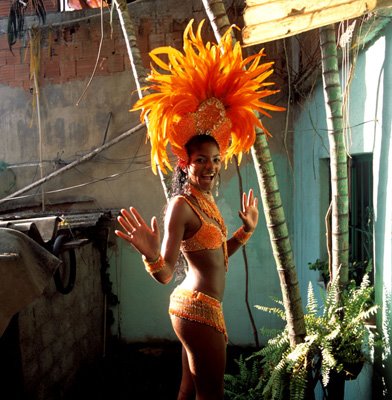
The beautiful samba dancers that have captured the imaginations of people far and wide also have the incredible stamina to samba through six days of non-stop carnaval.
These are same lithe bodies that interpret the deadly force of capoeira (Brasil's martial art form) as if it were a harmlessly delicate ballet. Many times I have stood in awe as I watched men and women choreograph their spinning kicks in the capoeira school.
I had that same feeling of wonderment when I watched pick-up soccer games in Brasil.
How could so many young men be so physically gifted with speed, graceful precision and fanciful creativity. These boys are so comfortable with the ball that it seems as though it is magically attached to the ends of their toes.
My mother would say of me: "he eats, drinks and sleeps music", because it always seemed as though my every thought and action was a rehearsal for playing music.
I am reminded of this phrase when I watch a great athlete with the tools of his trade.
As a young man who spent every waking moment practicing my craft and handling my tools, musical instruments, I can always spot 'that' kid. Only the soccer player who ate with his ball on his foot, who slept with his ball in his hands and drinks from the well of constant devotion to practice can do what Ronaldo and Ronaldinho (below) can do. The magic is in the time spent with their craft.
Unfortunately, in Brasil many young men have plenty of time on their hands.
One day it dawned on me that these boys were young enough for school but were not in school. Some were just old enough to work but they had no place to work. For them and for many such future Ronaldos and Ronaldinhos, there is more than enough time to dream of a life away from the desperate favelas or shanty towns that ring the outskirts of many urban centers.
The rest of the world has the same problem and unfortunately the same meager solution; give boys the dream of stardom in sports.
On the concrete playgrounds of Chicago's Cabrini Green housing project the next Dwayne Wade
eats, sleeps and drinks basketball. Somewhere in some rundown part of London, Paris or Naples some poor kid is dribbling a soccer ball on his foot while another kid in Santo Domingo tosses a baseball in the air. All of them dreaming of a perfect life after the beautiful game.


Sunday, June 25, 2006

A Baia de Todos os Santos

In the middle of the Bay of All saints, a young man finds a place to escape.

A quiet place to contemplate away from the teeming city of Salvador.

Home to the largest population of Africans outside of the African continent, Salvador is a treasure trove of African culture and traditions. By 1850 the city's port had received an estimated 3.5 million enslaved Africans. The wealth they generated enriched Salvador, Brasil's first capitol city.

The institution of slavery was not abolished until 1888 in Brasil. Today in Bahia, the most African of Brasil's states, Afro-Brazilians make up 80% of the population. Afro-Brazilians hold nearly half of the 35 Salvador city council seats but have only been elected to 3 of 63 positions in the state legislature. A growing consciousness among Afro-Brazilians has led to many political initiatives, including a slavery reparations movement.


Listen to: Voce Esta Na Bahia
From the CD: "Tristeza e Beleza na Cidade Negra"

Saturday, June 24, 2006

Nao Pode Ser

Não Pode Ser

Uma noite bonita na Ilha
A sensação do Amor

Perto de meu coração
A musica sensual
Nessa seresta feliz com você
Assim, Eu quis passar o tempo com você
Mas, N
ão Pode Ser Meu Amor,
Não Pode Ser

Nessa noite na Itaparica
A sensação do Amor
Nessa noite dançando
Eu me lembro seu ritmo
Seu corpo quente pertinho de mim
Assim, Eu quis passar o tempo com você
Mas, Não Pode Ser Meu Amor,
Não Pode Ser

Não Pode Ser

To hear this song from the CD:'Tristeza e Beleza na Cidade Negra' click the link above:


Thursday, June 22, 2006

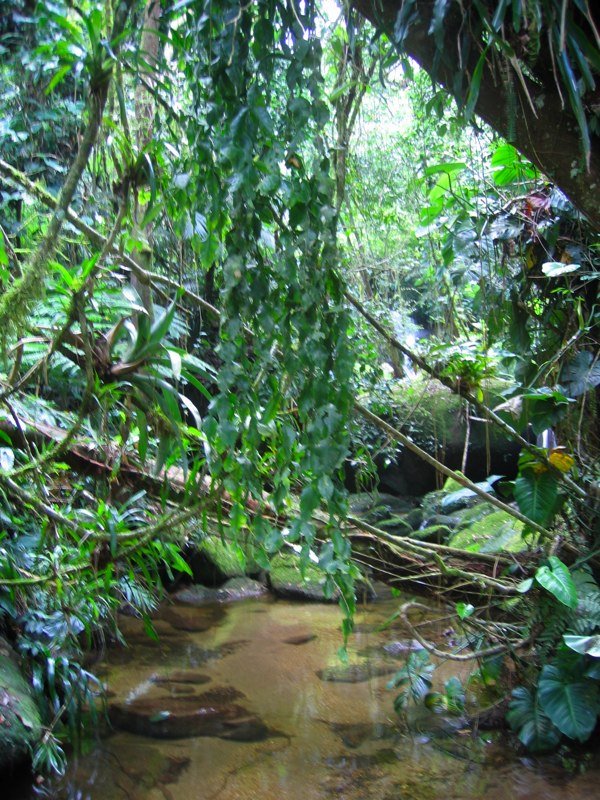
Os segredos da selva escondida.


A selva escondida
uma história perdida
quem era desaparecido
quem tinha morrido
um país tinha sido nascido

-rasheed ali


Sunday, June 11, 2006

The Call of Bahia


"A Chamada da Bahía"
Eu ouvi a chamada do berimbau
uma onda quente subindo em meu coração
uma lembrança de uma vida tropical
quem pode ser insensível
É Bahía.Quando você me chama eu voltarei

cdbaby.com/cd/rainpeople2


Thursday, June 08, 2006

My Favorite Movie: Black Orpheus


Black Orpheus (Orfeu Negro) 1959

My Favorite Movie!

According to mythology, Orpheus was the son of Apollo and the Muse Calliope. He was a poet and musician with whom many legends are associated. It was said that Orpheus could play the lyre so well that he could charm wild beasts and even make trees and rocks move with his music.

He married Eurydice, who was a nymph of the forest. They loved each other very much but one day she was bitten by a snake and died abruptly, leaving Orpheus inconsolable.

Orpheus went down to the Underworld to recover her and by his music induced the goddess Persephone and the ferocious guard dog Cerberus to let her go. They allowed Eurydice to return to earth on the condition that Orpheus not look back until both had reached the upper world. Orpheus agreed but when they approached the world of the living, he forgot his promise and looked back. Eurydice immediately vanished and was lost to him forever.

Later, when Orpheus was thinking of his love, meditating and playing music, a band of Thracian women who were were jealous of his love for Eurydice tore him to pieces and cast his head into the river Hebrus.

The director of this movie was Marcel Camus. It took the Greek myth of Orpheus and Eurydice and transported it into the tropical setting of Carnaval in Rio de Janeiro. The idea for it came from the Screenplay by Vinicius de Morais.
It was made in 1959, and received the grand prize at the Cannes Film Festival. Bruno de Mello and Marpessa Dawn were the main actors.

I now own this movie on DVD and it's even more beautiful than ever. I was in love with Marpessa Dawn,the gorgeous actress who played Eurydice,I thought she was an angel.


Tuesday, June 06, 2006

A cara que o mundo vê

The face that the world sees,
smiles today
The face that the world sees,
laughs at yesterday
The face that the world sees,
knows
that you will not be here
tomorrow,
to see her cry


-rasheed in Brasil 2006


Listen to: "Beleza" from the CD:'Tristeza e Beleza na Cidade Negra'


Tuesday, May 30, 2006

The Eclectic Music of Northeast Brasil


The music of Recife is some of the most forward-thinking music in all of Brasil.

NAÇÃO ZUMBI, Mestre Ambrosio & DJ Dolores are some of my favorites in this movement.
Music that combines the organic roots of the
sertão with the urban edge of the teeming Nordeste cities.
Accordions & violins with surdos, triangles and sampled hip-hop beats.
This music is honest,instead of sounding like some derivative mix.
It's about musicians who refuse to discard their roots as being passe.


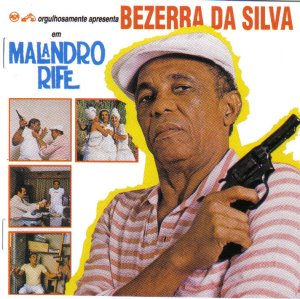
Bezerra Da Silva, Godfather of Gangsta Samba


The Man; Bezerra da Silva has to be one of the funniest songwriters in Brasil.
If Samba is the poorman's news report then Bezerra Da Silva is the news anchor of the Favelas. His
wry humor cuts to the painful underbelly of truth that lives outside of Brasil's
carefully crafted tourist image of Copacabana beach. This is raw Gangsta Samba not unlike the narco-corridos of Mexico's tough border towns but much more humorous.


I bought this in Brasil

Na Cidade Negra


NA CIDADE NEGRA

Aqui nesta Cidade foi nascido Ilê -Aiyê
Nossa Cidade Negra
é o Centro do Candomblé
Uma identidade cultural foi criada por aqui,

O quem tem entendimento minha gente, Diga a
í!
Ningu
ém pode revogar a nossa propia dignidade
A gente tem o namoro Dos Tambores da Liberdade,
uma rede da i
nspiração foi fundado por aqui,
O quem tem entendimento minha gente, Diga a
í!

Aqui todo mundo entra na paixão do Carnaval,
uma tradição enraizada, Nossa narrativa cultural
Uma onda Africana passa por aqui,
O quem tem entendimento minha gente, Diga a
í!


cdbaby.com/cd/rainpeople2

-as letras da canção: "Na Cidade Negra" por Rasheed Ali